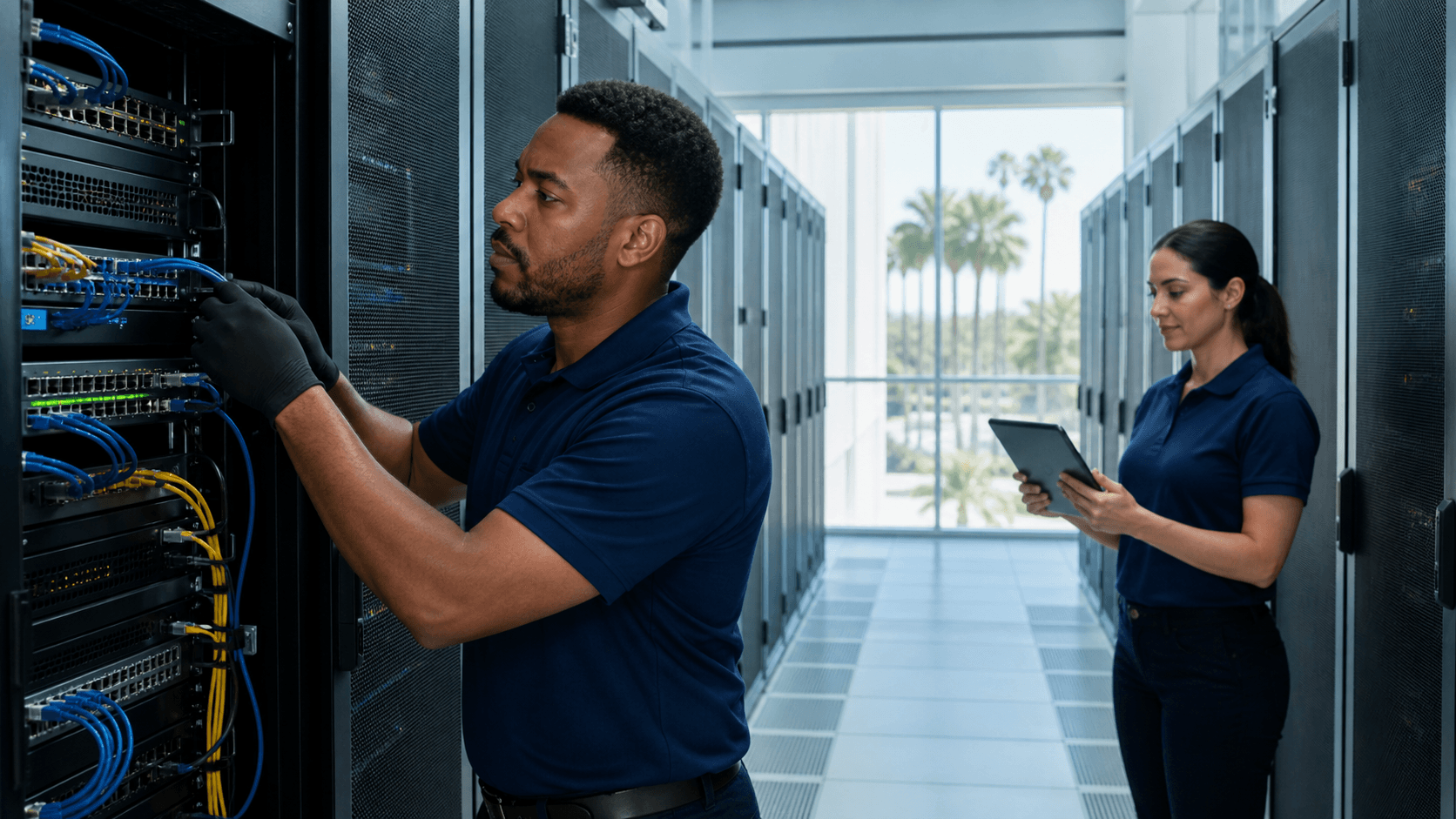
Protecting Uptime in an Uncertain World
Keeping your business online in Los Angeles is not just a technical goal; it is a survival skill. Late-summer heatwaves, wildfire season, and rolling brownouts can all hit at the same time. When that happens, your customers still expect every app to load, every order to go through, and every support channel to work.
That is what business continuity really means: your key systems, data, and connections stay up even when your local area is having a bad day. For many growing companies, choosing the right Los Angeles colocation provider is one of the most important steps in that plan. It is not only about moving servers into a different room, it is about choosing a partner that is built for disruption, not just normal days.
In this article, we will walk through what to look for in a colocation provider in Los Angeles, where the risks really are, and how a boutique partner can help keep you running and ready to grow.
Why Los Angeles Is a High-Stakes Colocation Market
Los Angeles is a strong place for data. Networks meet here. There is close reach to West Coast customers and important routes to Asia-Pacific. Media, entertainment, ecommerce, and tech are all nearby, and they need fast, steady connections.
That same location also brings special risks for on-premises server rooms sitting in office buildings or small suites. Local conditions can impact you in different ways:
- Summer heat that pushes building power systems hard
- Wildfire smoke that can affect air quality around your equipment
- Power grid strain that leads to brownouts or outages
- Earthquakes that can shake older spaces that were never meant for data
It only takes one event to knock out power or damage gear. When you run your own small server room, you carry all that risk yourself. That is why it is so important to look beyond simple specs like square footage, and instead ask how a Los Angeles colocation provider designs for redundancy, disaster readiness, and resiliency.
On top of that, many LA industries face higher expectations for uptime and data protection. Media companies cannot have long streaming interruptions. Tech startups must prove reliability to investors and users. Healthcare and ecommerce teams have to protect sensitive data and keep services available. All of this raises the stakes for where and how you host your physical infrastructure.
Evaluating Infrastructure Resilience and Redundancy
When you compare colocation options, the building and core systems matter as much as the racks. Strong marketing language is not enough. You want clear, specific answers in a few key areas.
For power reliability, ask how the facility rides through grid problems:
- Separate A/B power feeds to your cabinets
- UPS systems to smooth out short drops and spikes
- Generator capacity and how long they can run during an outage
- Fuel contracts and refueling plans when events last longer
- Regular testing and maintenance, not just gear sitting idle
Cooling and environmental controls play a big role during August heatwaves and long, dry seasons. Data gear does not like hot spots or wild swings in room conditions. Look for features like:
- Redundant cooling units so one failure does not stop airflow
- Hot and cold aisle containment to keep temperatures stable
- Continuous temperature and humidity monitoring
- Air filtration that can help during wildfire smoke events
Physical and structural resilience should not be an afterthought. Ask about the building itself: how it is reinforced for seismic activity, how fire suppression works, and how flood risk is handled. Layered physical security like controlled entry points, cameras, and access logs helps protect your equipment from human threats too.
Network redundancy is just as important as power. A strong Los Angeles colocation provider should have:
- Carrier diversity so you are not tied to a single network
- Blended bandwidth options for better routing and performance
- Multiple fiber entry points into the building
- Network designs that remove single points of failure
Assessing Support, Services, and Scalability
The best infrastructure will not help if you cannot get support when you need it. Late at night, on a weekend, or during a local event, you want to know that real people can act quickly.
- 24/7 onsite technicians, not just on-call staff
- Clear SLAs that spell out response times and responsibilities
- Advisory services that help with planning, not only emergency fixes
Growing businesses also need flexibility. You might start with a small footprint, then add more power or space as your customer base grows. Strong colocation partners offer:
- Partial and full cabinets so you can right-size your start
- Custom power densities that match your hardware, not just a simple standard
- Cross-connects to carriers, cloud on-ramps, and partners
- The ability to grow within the same facility without a painful migration
Business continuity is not only about where your servers live. It is about how you run when your main office is not available. Ask about:
- Workspace recovery areas where key team members can work if your office is offline
- Staging areas for new gear, testing, and change planning
- Help with disaster recovery planning and test exercises so your playbook is real, not just a document
This is where a boutique Los Angeles colocation provider can stand out. Instead of forcing every client into the same mold, a smaller team can listen to your specific needs and design around your business, your growth plans, and your risk tolerance.
Comparing Boutique and Hyperscale Colocation Choices
Many growing companies find themselves comparing large, hyperscale facilities with smaller boutique providers. Both have their place. The real question is what kind of partnership you want.
On the service side, very large facilities often lean on standardized processes and ticket queues. That can work for simple requests, but it can feel distant when you need deeper help. Boutique providers tend to offer a more relationship-driven approach, where you know the team working on your environment.
Customization and agility often look different too. A smaller provider can usually:
- Adjust power and space more quickly
- Help design hybrid deployments that mix colocation with public cloud
- Tweak network setups to match your application patterns
- Work with you on unique continuity or testing needs
Transparency and trust matter when you are putting your core systems in someone else's building. With a boutique partner, it is often easier to arrange detailed tours, talk directly with senior engineers, and get straightforward answers about design choices. In some cases, you can even share feedback that shapes future expansion plans instead of being one tenant among thousands.
As a Los Angeles-based boutique provider, we at DataHub Innovations focus on delivering enterprise-grade infrastructure with high-touch guidance around continuity planning. That mix is especially helpful for growing enterprises that need strong uptime but also want a real partner at the table.
Turning Evaluation Criteria Into an Action Plan
Once you know what to look for, it helps to turn it into a simple, repeatable checklist. When you visit or talk with a Los Angeles colocation provider, make sure you cover:
- Power redundancy and generator plans
- Cooling design and environmental monitoring
- Network diversity and carrier options
- Physical security and seismic readiness
- Support SLAs and onsite staffing
- Scalability options for space and power
- Business continuity and disaster recovery capabilities
Late-summer is a smart time to do this review. Many teams are looking ahead to year-end, peak holiday demand, and next-year planning. It is a good moment to step back, look at any outages or scares from earlier in the year, and decide if your current setup can handle the next round of heatwaves, grid strain, or regional events.
Turn your evaluation into a cross-team effort. Involve both IT and business leaders. Ask providers for detailed infrastructure diagrams, uptime metrics, and incident history. Plan site visits so you can see the facility with your own eyes and ask follow-up questions in real time.
For companies that want a more guided approach, we at DataHub Innovations can walk through your current environment and help shape a colocation and business continuity roadmap tailored to the Los Angeles market. That way, your next disruption becomes a test you are ready to pass, not a surprise that takes you offline.
Get Started With Your Project Today
If you are ready to improve reliability, performance, and security for your infrastructure, our team at DataHub Innovations is here to help you plan the next step. As a trusted Los Angeles colocation provider, we work with you to design a solution that matches your technical, compliance, and budget requirements. Reach out to our experts today so we can review your needs and outline a clear path to a more resilient and scalable environment.